
-
- Overview
- The DH world
- Case Studies
- News
- FAQ
- Quality
- About us
- About DH electronics
- TOP 100 Innovator
- Career
- Developer world
- Support
- Events


 down
Date : 9. November 2026
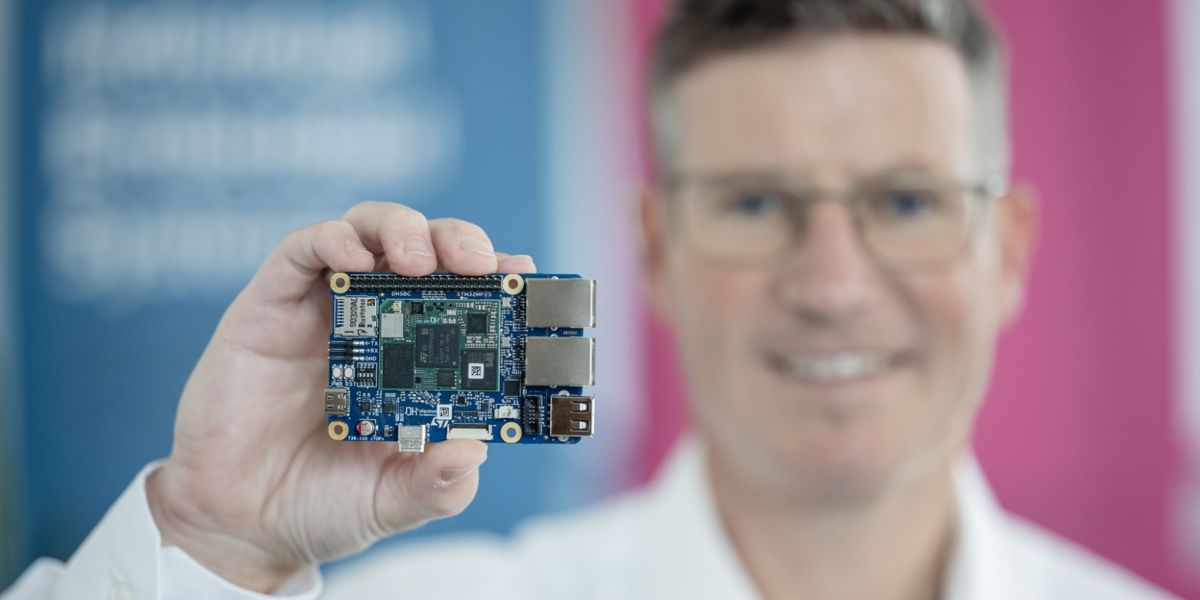
Zephyr now supports the DHSBC STM32MP255C and the DHSBC RS-485 CAN Shield
Our Single Board Computer DHSBC STM32MP255C and the DHSBC RS-485 CAN Shield now have board support in Zephyr, with documentation and ready-to-run samples.
Zephyr has been extended with support for the DHSBC STM32MP255C. Applications run on the board’s integrated Arm Cortex-M33. The support is part of the official Zephyr project, so you work with the existing samples and build tooling and don’t depend on a separate vendor tree.
Board interfaces
The board’s common communication interfaces are supported. By default, FDCAN1, UART4 and SPI8 are enabled and available on the 40-pin header. Support for SPI8 was newly added to Zephyr as part of this work.
DHSBC RS-485 CAN Shield
The shield is supported as well. The RS-485 interface sends and receives data over UART, with GPIO signals controlling the transmit and receive direction. It works with Zephyr’s Modbus sample applications, such as the Modbus RTU client and server.
CAN-FD uses the CAN controller integrated in the STM32MP255C, so the shield only needs a CAN transceiver to handle the signals on the physical bus. The interface works with existing Zephyr samples such as “CAN Babbling” and “CAN Counter”.
Open to other shields
For the 40-pin header, support for Zephyr’s GPIO nexus nodes was implemented as well. This makes it possible to connect other Raspberry Pi compatible shields, provided their interfaces and hardware configuration are supported.
From prototype to your own product
Board and shield are built for industrial use, –40 to +85 °C, with 10+ years of long-term availability. If your project needs more interfaces or grows in volume, we can develop a custom board with you on the same DHSOM basis.
Documentation
Zephyr provides detailed documentation for board and shield, including how to build and flash the samples:


