
-
- Overview
- The DH world
- Case Studies
- News
- FAQ
- Quality
- About us
- About DH electronics
- TOP 100 Innovator
- Career
- Developer world
- Support
- Events


 down
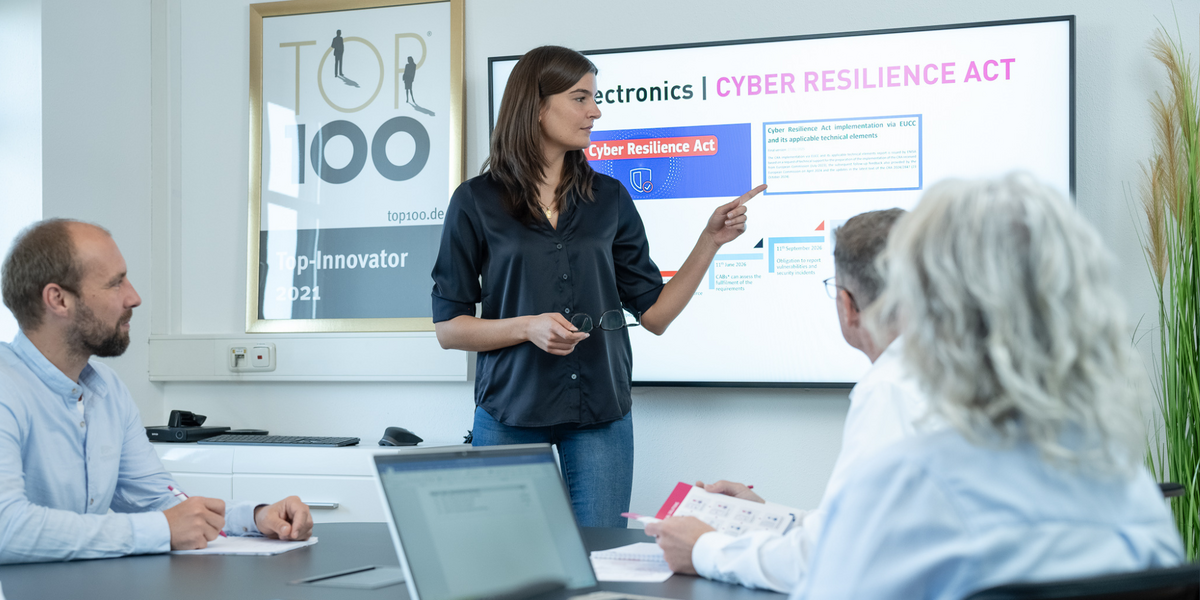
Date : 25. November 2026
Documentation, evidence, and regular vulnerability checks: we're currently working on this part of the Cyber Resilience Act's requirements. The technical foundation has been in place for years, starting with our decision to adopt mainline Linux in 2019. It grew out of one question: how long can a device's software actually be maintained?
How the technical foundation came about
SoC vendors focus their software maintenance on their current SoCs. As a chip ages, more of the effort moves to its successors, and response times for security and bug fixes get longer. Eventually, the vendor stops maintaining an older board support package (BSP) altogether. You usually can't tell when that will happen at the start of a project, and for products with long lifecycles, that's exactly the risk. The maintainability of our devices, which stay in service much longer, would then depend on the priorities of SoC vendors. That's why we have built on mainline Linux rather than the vendor BSP since 2019. Mainline Linux is maintained by the community, so it doesn't depend on those vendor decisions. Any work the SoC vendors upstream themselves is included there as well.
Mainline Linux only helps, however, if support for our modules is actually included in the kernel. Otherwise we would have to keep maintaining it as our own patches, and that's exactly what we want to avoid. But a computer module can't be upstreamed on its own, because it isn't a working device with peripherals. So we upstream our developer kits, carrier boards, and Single Board Computers as maintained reference platforms. We've done this for all current SOMs, and all of our modules run on mainline Linux and Yocto. The result: our BSP layers need only a few patches, and anything we upstream is available to us in the next long-term support (LTS) release of mainline Linux. Beyond the reference platforms, we contribute selected software components back to the community.
On top of this independence, we follow a fixed update cycle that tracks the releases of the following projects. A new Linux LTS kernel comes out every year in Q4, and a new Yocto LTS release every two years in Q2. Our BSPs based on them follow right after: kernel updates in Q1 of each year, and Yocto updates in Q3 of a two-year cycle. The U-Boot bootloader is updated to the matching major release along with the Linux kernel. We also provide minor updates and patches.
All of this is part of our free customer support. As described above, we maintain our reference platforms for their full product lifetime and beyond. Customers get access to the BSP source code and documentation, along with direct support from our developers.
What changes with the CRA
At first, the practice described above changes little for us. What changes is its status: what we did voluntarily becomes a legal obligation. The reporting obligations have applied since September 11, 2026, and the rest of the regulation's requirements become mandatory on December 11, 2027. Maintaining the software is no longer enough on its own. We also have to be able to document and prove it.
The 2019 decision is therefore a prerequisite, but it doesn't meet any of the regulation's requirements by itself. To close a vulnerability quickly, you need an actively maintained codebase and an established way to get a fix all the way into the device in the field. Both take years to build, not months. Most of the requirements, however, concern documentation, evidence, and the processes behind them. Some of that is still incomplete on our end.
What we're working on now
The CRA requires manufacturers to handle vulnerabilities in their products and to be able to prove that work. To do that, you first need to know which software components a product contains. So we're starting with the software bill of materials, or SBOM. Yocto can already generate one: for each software image, it produces an SBOM in SPDX format, the widely used standard for software bills of materials. The SBOM lists package names, versions, licenses, sources, and applied patches. It is machine-readable and can be built into a build pipeline. The community maintains this Yocto feature, and it costs nothing in license fees.
The SBOM is meant to be the basis for checking for known vulnerabilities, known as the CVE check. Yocto's built-in tools haven't been good enough for this so far, so we're evaluating better-suited tools.
Where we're headed
Our next major step is a regular, automated CVE check. A single CVE check only shows the state at the moment it runs. Our devices, however, stay in service for years, so the CVE check has to be repeated at regular intervals.
Without automation, a lot of manual work remains, and that can't reasonably be handled across a larger number of devices. On top of that, a CVE assessment doesn't mean much without looking at the specific use case. Making CVE checks regular and automated is what we're tackling next.


